
SEND expertise in every programme
All Compass tutors and mentors complete SEND and inclusive-practice development before or during induction, followed by regular training, supervision and feedback throughout their work with us.
A consistent foundation for every practitioner
Our SENCo-led induction establishes a shared standard for understanding need, adapting practice, building engagement and supporting independence. Open a topic to see what it covers.
Compass SEND & Inclusive Practice InductionCompass · SENCo-led internal training · Before or during induction
Understanding SEND and the four broad areas of need; individual learner profiles; reasonable adjustments; inclusive practice; maintaining high expectations; and knowing when to seek additional support.
Practical SEND StrategiesCompass · Internal training · Mandatory
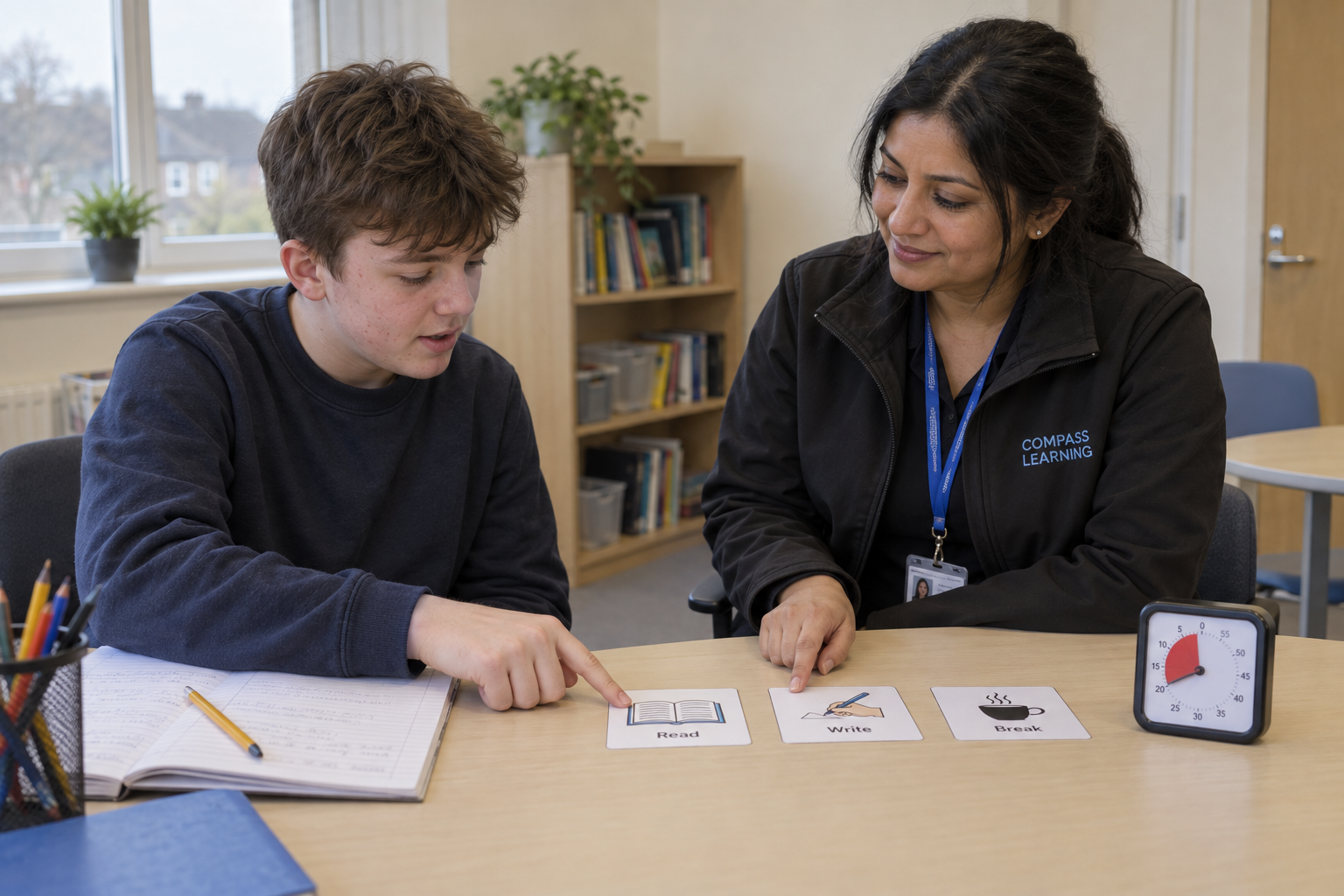
Practical adaptations for autism, ADHD, dyslexia, speech, language and communication needs, sensory needs, working memory and processing difficulties. This includes chunking, scaffolding, modelling, visual support and reducing cognitive load.
SEMH, Anxiety & EBSACompass · Internal training · Mandatory
Understanding barriers to engagement; anxiety-aware and relational practice; emotionally based school avoidance; graded engagement; and supporting appropriate reintegration.
Supporting Neurodivergent LearnersCompass · Internal training · Mandatory
Autism, ADHD, executive functioning, sensory differences, regulation, predictability, communication and appropriate adaptation of teaching and mentoring.
Behaviour as Communication & De-escalationCompass · Internal training · Mandatory
Looking beyond presenting behaviour; identifying barriers and triggers; low-arousal responses; avoiding power struggles; co-regulation and safe de-escalation.
Supporting Independence & ReintegrationCompass · Internal training · Mandatory for outreach and mentoring staff
Scaffolding without creating dependency; increasing learner independence; setting small-step outcomes; and supporting transition or reintegration into education, training or employment.
Whole School SEND core learning
Core external professional development strengthens emotionally safe, person-centred practice and practical understanding of barriers to learning.
Creating an Emotionally Safe EnvironmentNASEN / Whole School SEND · Core external CPD
Creating learning environments in which learners feel emotionally secure and able to participate.
Understanding Behaviour as CommunicationNASEN / Whole School SEND · Core external CPD
Understanding what behaviour may communicate and adapting practitioner responses accordingly.
Understanding Anxiety & Creating a Supportive Learning EnvironmentNASEN / Whole School SEND · Core external CPD
Recognising anxiety-related barriers and implementing practical supportive strategies.
Supporting Sensory DifferencesNASEN / Whole School SEND · Core external CPD
Understanding sensory differences and adapting the learning environment.
Understanding Executive FunctioningNASEN / Whole School SEND · Core external CPD
Supporting planning, attention, organisation, inhibition, task initiation and other executive-function skills.
Memory for LearningNASEN / Whole School SEND · Core external CPD
Understanding working-memory barriers and adapting instruction and learning activities.
Person-Centred WorkingNASEN / Whole School SEND · Core external CPD
Keeping each learner's strengths, aspirations, needs and voice central to planning and delivery.
Promoting IndependenceNASEN / Whole School SEND · Core external CPD
Developing independence rather than long-term reliance on adult support.
TransitionsNASEN / Whole School SEND · Core external CPD
Supporting learners through transitions between settings, phases and pathways.
Specialist and role-dependent development
Additional learning is selected where a tutor's role or a learner's profile calls for more focused knowledge.
Speech, Language & Communication NeedsNASEN / Whole School SEND · Role-dependent CPD
An introduction to SLCN, identifying barriers, supporting communication and creating communication-supportive learning environments.
Supporting Reading & ComprehensionNASEN / Whole School SEND · Role-dependent CPD
Supporting literacy and comprehension across the curriculum.
Dyslexia in Education: Understanding Hidden DifficultiesBritish Dyslexia Association · Specialist CPD · Secondary
Recognising and understanding dyslexia and developing appropriate support for dyslexic learners in secondary education.
An Introduction to Assistive TechnologyBritish Dyslexia Association · Additional specialist CPD
Understanding technology that can support dyslexic and other neurodivergent learners with literacy, organisation and access to learning.
Ongoing review, supervision and feedback
Induction is the starting point. Practice is revisited through supervision and observation so that adaptations remain responsive to each learner.
SEND Practice Review & Reflective SupervisionCompass · SENCo and quality assurance · Ongoing
Discussion of learner needs, strategies that are or are not working, adaptations required and opportunities for further CPD.
Session Observation & FeedbackCompass · Quality assurance · Ongoing
Observation of tutoring and mentoring practice, including differentiation, relationships, learner engagement, SEND adaptations and progress towards outcomes.
Discuss a placement with the Programme Lead team
Tell us about the learner and we will advise on suitability, delivery options, availability and what a placement would include before anything is agreed.